
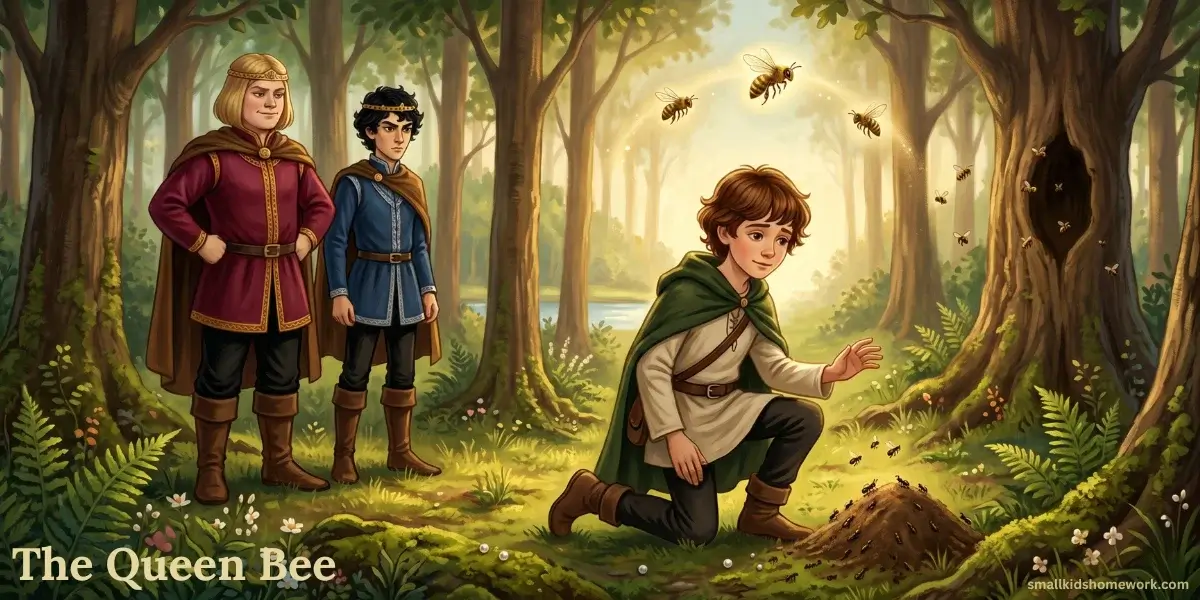
A classic German fairy tale collected by the Brothers Grimm in 1812. Best for ages 5 to 8 as a read aloud, or for early independent readers in 2nd grade.
The Queen Bee
A king’s three sons set out together to see the world.
The youngest was called Simpleton, and the other two often laughed at him.
They traveled on until they came to an anthill.
The two elder brothers wanted to tear it apart, to watch the little ants scramble in terror and carry their eggs away.
But Simpleton said, “Leave the creatures in peace.
I will not let you trouble them.”
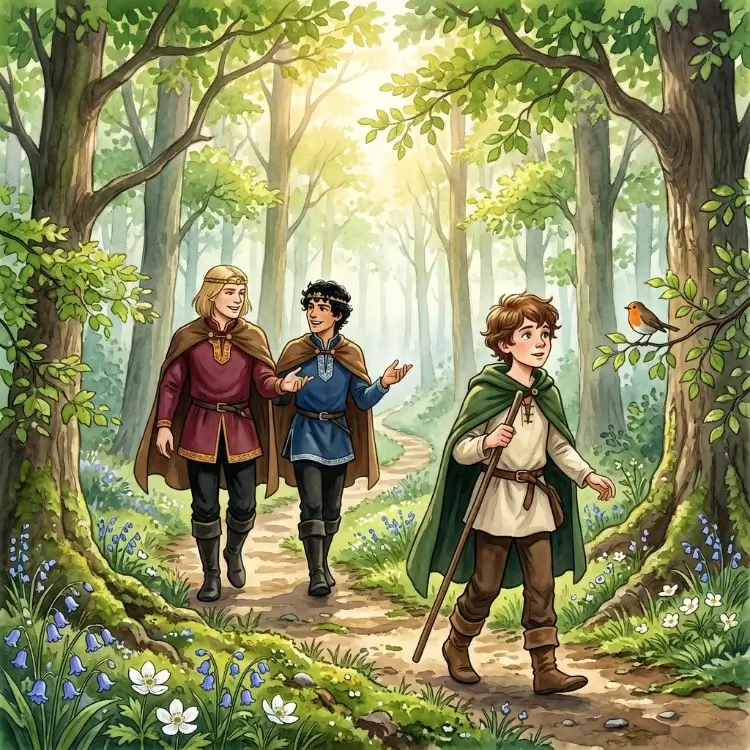
They went on and came to a lake where many ducks were swimming. The two brothers wanted to catch a few and roast them, but Simpleton would not allow it. “Leave the creatures in peace,” he said. “I will not let you kill them.”
At last they came to a bees’ nest in a hollow tree, so full of honey that it dripped down the trunk. The two brothers wanted to light a fire under the tree, smoke out the bees, and take the honey.
But once more Simpleton stopped them. “Leave the creatures in peace. I will not let you burn the queen bee and her nest.” His brothers grumbled, but the queen bee remembered.
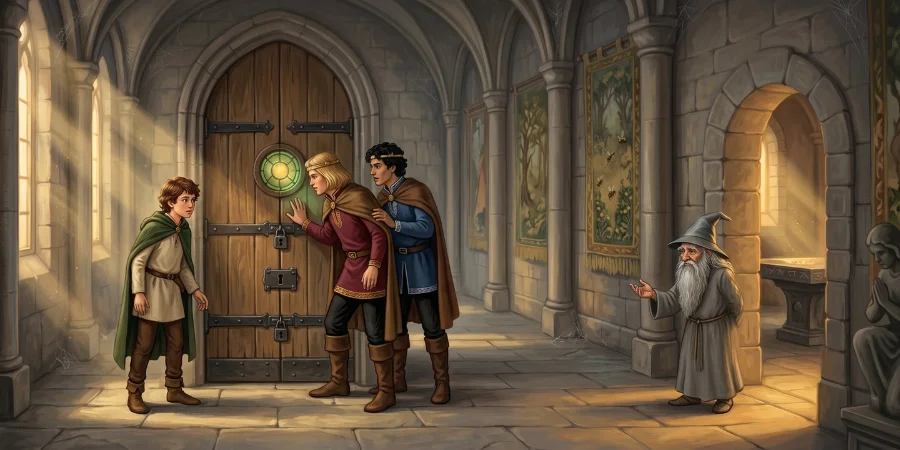
The three travelers came at last to a castle where no person could be seen. They walked through hall after hall until, at the very end, they found a door with three locks. In the middle of the door was a small pane of glass, and through it they could see into a room where a little gray man sat.
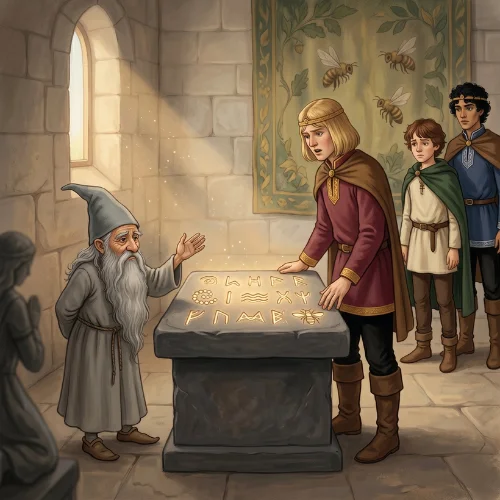
He came out, beckoned to them without a word, and led the eldest brother to a stone table.
On the table were carved several tasks and pointed towards three tasks.
Whoever completed all three would break the enchantment over the castle.
Whoever failed would be turned to stone. All three brothers agreed to complete the three tasks and decided to complete them at the earliest.
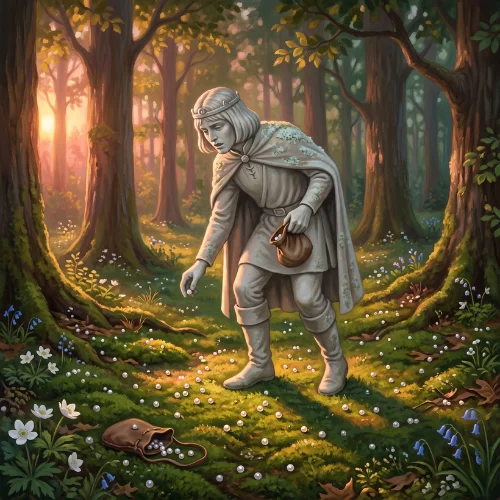
The first task: a thousand pearls belonging to the king’s daughter lay scattered in the forest moss. They had to be gathered by sunset.
The eldest brother searched all day and found only a hundred.
He turned to stone where he stood. The next day the second brother tried.
He found two hundred. He, too, turned to stone.
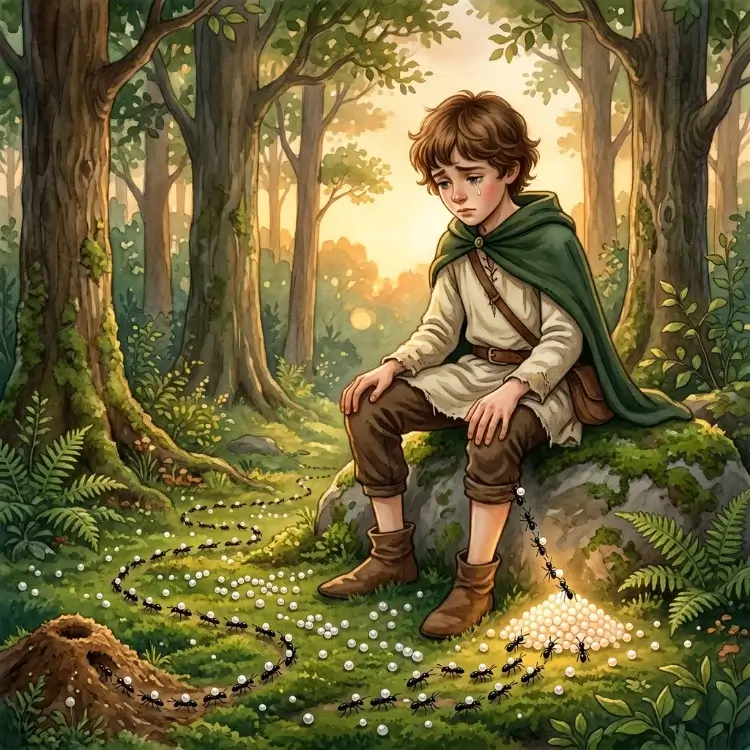
Then it was Simpleton’s turn.He searched and searched, but the pearls were so small and the moss so deep that he barely found any.
At last he sat down on a stone and wept.
And while he wept, the king of the ants, whose home he had once protected, came up to him with five thousand of his ants.
Before long the little creatures had gathered every pearl into a neat heap at his feet.
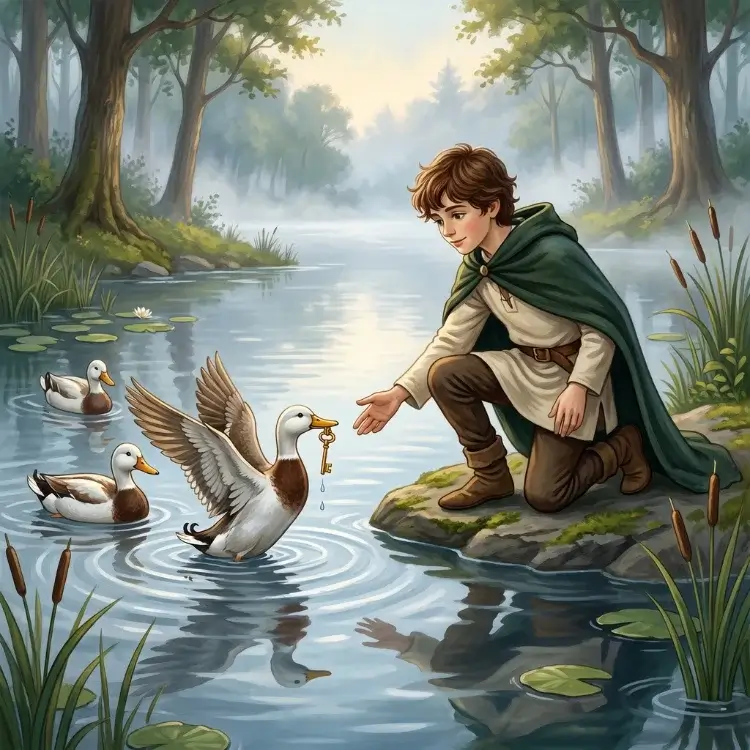
The second task was to fetch the key to the king’s daughter’s bedchamber from the bottom of the lake.
Simpleton went near by pound.
When Simpleton reached the water, the ducks he had saved swam up to him, dived down.
Ducks brought the key to the surface. Simpleton thanked ducks for helping him in this hour of need.
The third task was the hardest. The king had three sleeping daughters, and Simpleton had to pick out the youngest and dearest.
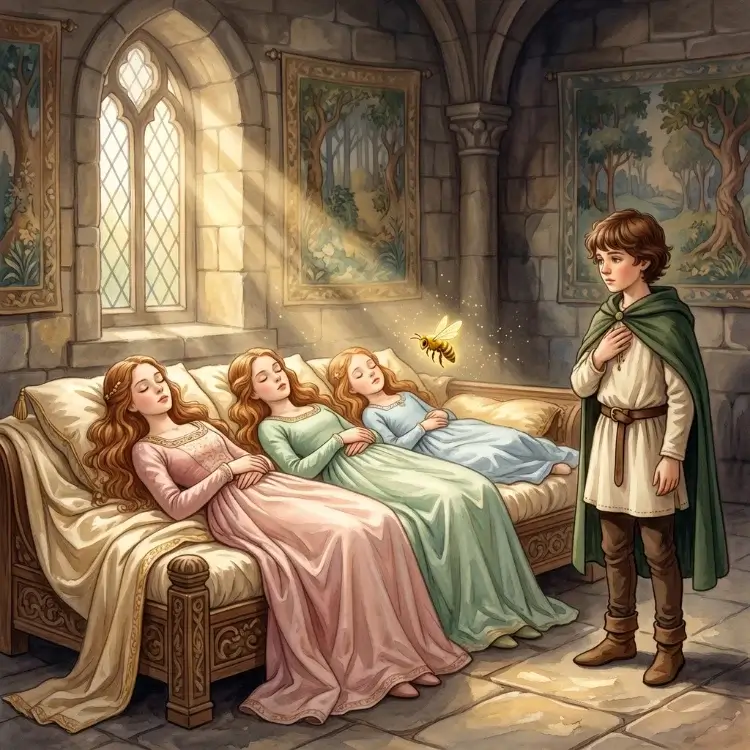
The three princesses looked exactly alike. The only difference was what each had eaten before falling asleep: the eldest a piece of sugar, the second a little syrup, the youngest a spoonful of honey.
Then the queen bee, whom Simpleton had saved from the fire, flew in at the window.
She tasted the lips of all three sleeping princesses and rested at last on the mouth that had eaten honey. So Simpleton chose the right one. The enchantment broke. The two stone brothers became flesh again.
Simpleton married the youngest princess, and his brothers married her sisters, and in time Simpleton became king.
💡 Takeaway: Simpleton wins the kingdom because he refuses to harm three small creatures. The Queen Bee isn’t about being clever. It’s about being kind when no one is watching.
What The Story is Really About
The Queen Bee is the rare Grimm tale where the hero wins not by cleverness or courage but by restraint. Three times, Simpleton’s only action is choosing not to act. His brothers want to wreck the anthill. He says no. They want to roast the ducks. He says no. They want to burn the bee tree for honey. He says no again.
That is the whole heroism, until the very end. For a child who is constantly told to do something, to try harder, to be braver, to speak up, this is a story about the kid who didn’t poke the anthill, and how that turns out to matter.
How to use this story at home or in the classroom
A handful of ways the story works well in practice:
- Stop after each “leave the creatures in peace.” Ask your child: why do you think Simpleton said no? What would the brothers say if they were telling this story?
- Connect it to a real moment. If your child has recently chosen not to do something, perhaps not snatched a toy, or not stepped on an ant, call it back to Simpleton. The link is more powerful than any moral statement.
- Compare it to other Grimm tales. The Queen Bee is one of several Grimm stories where the youngest of three brothers wins by being kinder, not cleverer. Pair it with a reading of Cinderella or Rapunzel.
What your child learns
- Vocabulary. Words like enchantment, sweetmeats, moss, bedchamber, and pane expand a kindergartner’s word bank well past picture-book level.
- Story structure. The rule of three (three brothers, three tasks, three sleeping princesses) is a backbone of Western storytelling. Kids start to predict it by the second reading.
- Empathy through narrative. Simpleton’s mercy isn’t preached. It’s shown three times in a row, then rewarded. Kids absorb the pattern.
- Patience. This story takes longer than a picture book. Sitting through it is itself a skill.
More Fairy Tales To Read Next
If your child loved The Queen Bee, try these:
- Cinderella, another youngest-child-wins Grimm tale
- Rapunzel, for the enchanted tower
- Thumbelina, a tiny heroine and a kind animal friend
- Browse the full Fairy Tales collection
Curriculum Alignment: Aligned with Common Core State Standards: RL.K.5 (Recognize common types of texts, including stories). Suitable for Kindergarten Read-Aloud, 1st and 2nd Grade Reading, Homeschool, and ESL Elementary Reading.

Madhu is the founder and lead author of SmallKidsHomework.com, a free learning site she started in 2009. She writes the poems, fairy tales, folktales, coloring pages, and kindergarten worksheets here, many tagged to Common Core standards. She tests printables with real children and keeps everything free, with no signup needed.